Welcome to my revised costuming pages. My previous pages were heavier on the gallery side and less on the helpful side so I decided to reverse that since all the pretty pictures in the world are not 1/10th as helpful as a few paragraphs of detailed explanations and instructions. This page is still in its infancy and hopefully Ill be adding more stuff about Gryph as I continue to get him ready for MFF.

The is open 24/7. Dont be afraid to ask questions. You'll never get the answer to the question that you don't ask. If you want to see picture/angle of headpiece feel free to ask, I have a digital camera and can usually get the image request within48 hrs.


(canine)
This is a decent shot of the basic frame with nothing attached. All the pieces are visible but what I cannot stress enough is the muzzle location. In a perfect world the muzzle would line up on our nose and mouth. In the real world the muzzle would actually start just above our nose and the bottom of the muzzle would be around our lower lip. The lower part of the muzzle(lower jaw) will go from our lower lip to bottom of the chin. This is esential becuase other wise you get a "double chin" as the lower law will not run from the tip of the muzzle to our throat unobstructed. There will be a slight "bump" if you decide to use an articulated jaw from the control mechanism but it can be hidden with fur and a slight tilt of the head.
One more thing: the nose. Study animal noses. They arent what most people imagine. Frry's nose is awful. I did not make the same mistake with Windancer.

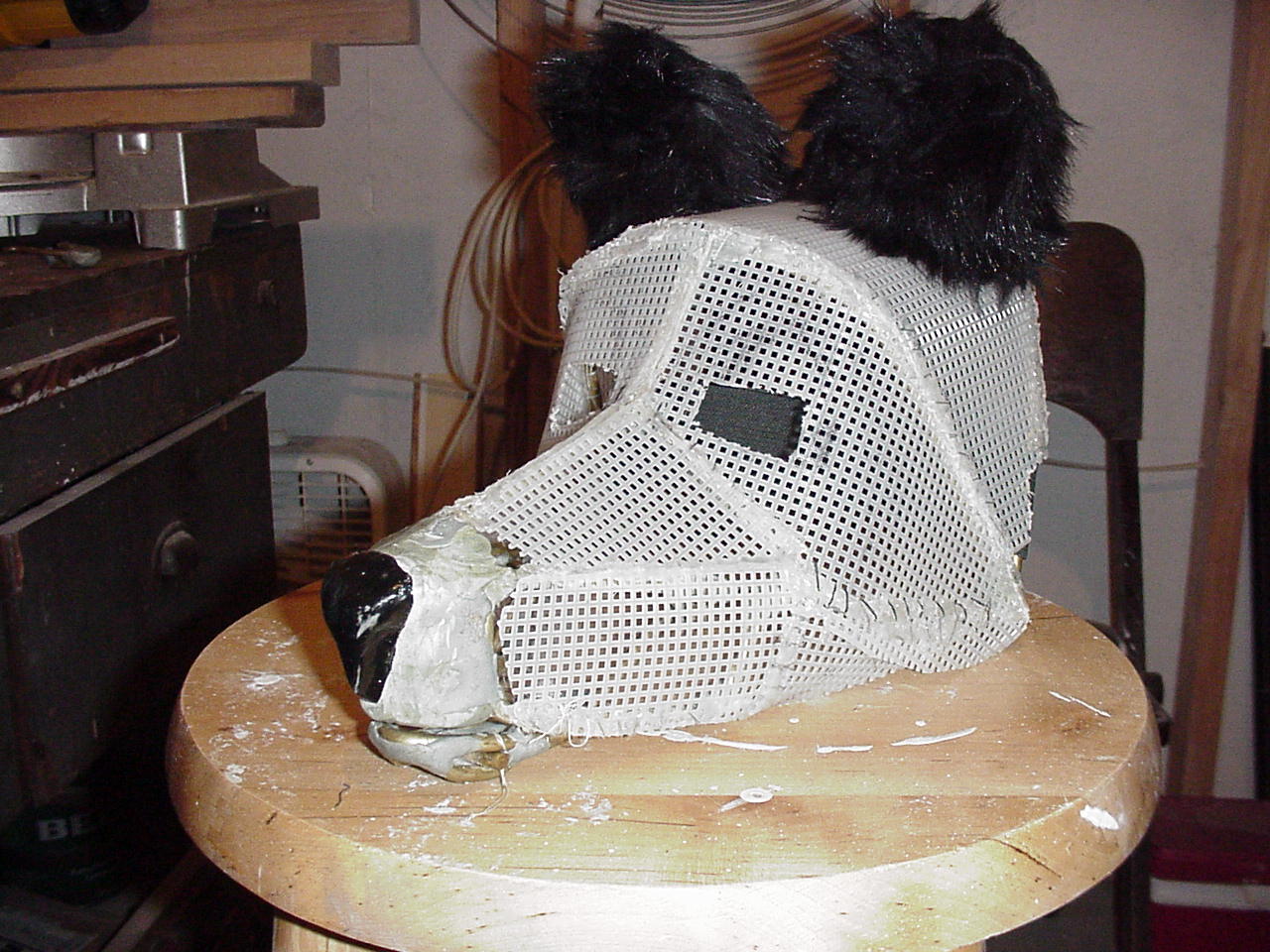
(canine/lupine)
Here we see the mesh on the headpiece. At this point the species of the creation takes shape. By rounding pieces of the mesh, placement of the ears (type of ears), eye position etc really gives the headpiece dimension. The mesh does not have to touch the frame all the time. On Windancer I made the smooth curves on his face by tieing and glueing the mesh down at one point then drawing it over the sharp corners of the frame and then glueing it down again. To add more curve I then tied parts of the mesh in the center to the frame. For OpenGL programers out there think NURBS or bezier surfaces and control points. .

(canine/vulpine)
It seams like a big jump from the last picture to here but its a smaller jump that from the frame only to the mesh on the frame. At this point its just a matter of sewing or glueing the fur to the mesh. Blending the fur colors/fabrics can be a pain in the --- but here is a secret. Sew the lower color first (the white on Frry). Then cut the top color slightly bigger than required. Roll the edge of the pattern under just slightly but keep the fur from rolling under as well. Make very small but tight (tension wise) stiches to eliminate the bump from the rolled under edging. When brushing down its totally seamless and when brushed upwards the fur from the rolled under part keeps the mesh from showing as well as minimizing the seam (only the slight ridge from the rolled under part can be felt). Granted for long pile or dense pile fabrics you dont need to do this as the thick long fur totally hides the seams but for thinner fur its a good idea.

And introducing Gryph:
 

(gryphon) Gryph owes part of his looks to a fellow griffin, Legend. The idea of using a hockey helmet (goalie) for the base of a headpiece is not new but I was not about to sacrifice my $300 triple kevlar lined pro-model Bauer to costuming. I had side-lined the idea until I read about C.Kellner using a street-hockey goalie helmet ($30). Using some of the 125' of 9ga steel wire I have left (same stuff I use for tails, as well as many other costumers use for tails) Gryph's beak frame was assembled. Using plastic lock ties to secure the plastic mesh to the wire and then Plumber's Epoxy Putty, the beak was slowly molded and sanded. The lower beak was added totally separate but the same way. Currently there is no mechanism to ariticulate/move the lower jaw but it is designed to have it added later. Right now the wings are getting an minor design upgrade based on an idea/concept from Legend's original (unpowered) wing design. C. Kellner had tossed around the idea of moving the wings from his chest/shoulder movement. With his current design thats impossible, but not from my design. Just not the movement that you are thinking of.......